アテニジカール . 아테니에세만도: Art, Ideas, Voice, ESL & Zen / Welcome to 8 Fold. I’m Carl, from New York–in Japan and sometimes in Korea. I make pictures, poems, essays, voices, podcasts, videos, am writing a book and sometimes I do comedy—but only when people and other animals laugh! Thanks for stopping by.
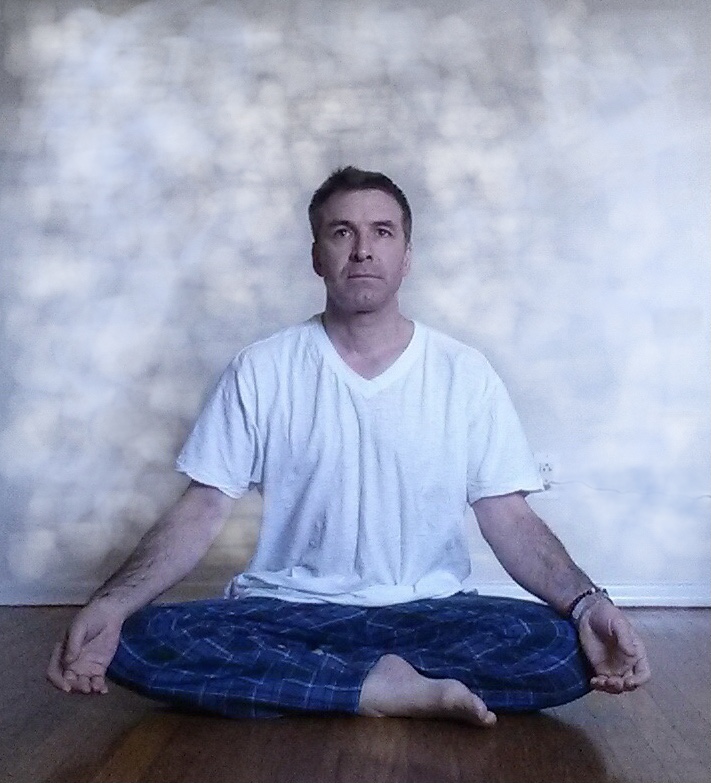
There are different forms of meditation and different methods via which to achieve its benefits.
In my opinion, the most useful form of meditation is vipassana. I think this way, because from what I understand about it, it is not goal-oriented—at least in the Zen sense:
What I mean by non-goal-oriented is, it is not like lifting weights or taking a business seminar.
Of course, when we approach meditation, more or less we are doing it, because we think it is good for us; some of us for a greater sense of peace, for improved health, for better focus–but if we really understand meditation, spiritual, meditation, we don’t do it expecting anything–or at least we shouldn’t, because it is really a practice, in its true and purest form, of simply being; and it is a practice of allowing ourselves to “be”.This is how we learn ourselves–the most important activity we can engage in. In this way meditation helps us reach better understanding and thatis what may lead to peace and focus and better health.
Meditation will open your mind…. to you.
So–meditation is a strange thing;people also sit to attain greater wisdom, as have millions of spiritual seekers, but we have to have the wisdom to know what meditation can do for us before we begin–to some extent; therein lies the conundrum–doesn’t it, my friend?
If you accept that, then… despite it’s not being goal-oriented, it yields many benefits. And as a non-goal oriented form of meditation, it can create little to no anxiety–unless you are one who is prone to discomfort by quiet and introspection; yes, there are people who grow anxious if they sit in solitude. If you are one of these people, you may not be ready for meditation of this type.
Vipassana is meditation in which we do not try to think. Of course we will experience the passing of ideas, visions and stimulus, but we do not engage these manifestations of our consciousness–or try not to. This is useful for a host of reasons–one of which is the afforded opportunity to observe our mind, as if it were separate from us in the first place: it’s not. You don’t have a mind;you are your mind.
Observing our mind allows us to become acquainted with how we think, what we think of and the quality and nature of our thoughts. This could be considered the best ways to honor Plato’s “know thyself.” It’s helpful to know yourself. It is different from professing whom you are. We often see ourselves in ways that do not reflect the truth–certainly not to others, who can only see us from the outside. This is helpful–and dangerous. We often are misunderstood–especially when out of our element. We can also behave outside the range we would often expect ourselves to when in familiar surroundings–but now in different surroundings, we find ourselves reacting–and in undesirable ways. This is what happens when we experience culture shock. Culture shock can happen in your own country, in your own province or state; it can happen when meeting people who behave vastly differently from what we are used to. So, at home or abroad, among friends or strangers–the better we know ourselves–and indeed, the better we cultivate our mind–the more we may present an even demeanor–even when in strange situations that shock, confuse or irritate us. This can be achieved with meditation–by knowing yourself, and knowing what kind of self you want to be.
To be continued….
Until then, peace love and joy to you and yours. How? “Peace is every step.” – Thich Nhat Hanh
So much of our happiness depends on our perception of the future and past that we must remember we only exist in the present — if we are to survive our darker ideas about both. Me, at yet another temple in 2022, in Japan; because–what else was I going to do given the situation–go on expensive trips? LOL. / Photo: Marcus Powles
Hi. Sit wherever you like.
Note to The Reader (that’s you): There is a short–a very short–version of the help-portion of this article to be found in the menu. Or, you can scroll all the way to the last paragraph.
Here I will talk about different reasons we get hurt and hurt others—and then what to do in the moments in which memories and bad feelings from these events plague us….
Getting Hurt Having a tough time? These days, I often am–and in the last 13 years or so, I have had some real butt-kickers. It’s strange, right? You mean well your whole life, have never caused any trouble to speak of (at least, you think), you do your best, but you still wind up tripping up–hurting someone, someone hurts you--“for no reason” (which, by the way, in reality, never happens)–or “worse” (for you), you find out mean-spiritedness isn’t just in the news or in the movies–people deliberately trip one another up. People can actually do to you what you would never have had a nightmare about, wanting to do to someone else.
Learning The Hard Way in Korea And Japan These things have only seemed to happen to me in New York City, Long Island and Japan. Of course some undesirable things happened to me and others in Korea—as a result of my rashness in youth and circumstance. These things weren’t entirely the doing of others, but even when I had tricky bosses, mean supervisors, assailants (yes, I was chased by a gang in Seoul, once, beat up–to a degree, and needed a leg cast–for merely carrying someone in my arms; well, I had cursed at the gang—afterthey had cursed at me).
And another time (of course it was another time; could you imagine more happening to me after being beat up by a gang—on that same day? I’m not Tom Cruise, you know!)…. I had someone come at me with a knife, a gangster chase me through an alley, a livingtel employee throw me against a wall, a hotel clerk deny me service for my skin color, a school boss threaten me—but other than that, I had really good experiences in Korea…. Really! You’re laughing. It’s okay. Laugh. It’s funny now.
I also saved a few people from earning multiple broken bones on several occasions, in Korea. Really. And I possibly saved two out those three from death—but then—another time, I had to hit a young man in a bar—well… actually, no, I didn’t have to; he was bothering me for a while and wouldn’t stop, but I was a wee bit drunk (and hanging out with a guy who sort of brought that side out of me; I no longer drink and I no longer hang out with tough guys). I should have walked away—and another time, I did hit a man in a sauna locker room—because he wouldn’t leave me alone, either. This guy followed me into the shower and was harassing me. I don’t even know what about. Then he followed me to my locker. He was probably a xenophobe. Later, when I was stretched out, ready to sleep in the sleeping area, the manager I don’t even know what about. passing by—gave me the thumbs up—but I don’t like to hit people, and have avoided violence most of my life…. Korea was a special case. This is a very warm and compassionate country, but a very tough one—with a painful history and a few cultural features that can harbor resentment and pain in people, so in certain areas—especially in those days—a foreigner needed to be mindful of where he was and what he said and whom he showed off. I mean, I was often called out to from behind—told not to be with the girl I was, or she was told to not be with me as we walked along at night. But for the most part, Koreans are sweet people. And it is very different there, today. But those guys in Itaewon did get blood on my shirt, though….
I’m not bragging—and I’m not complaining, here; I understand those ignorant, good-for nothing, xenophobic, young jackasses who sent me to the hospital. Wink. They were just dumb kids—dumb kids in a homogeneous society who hadn’t grown up in a multicultural, cosmopolitan environment, and who knew nothing of me and my good track record, nothing of my intentions—nothing of the world, really—and didn’t care. They were toughs in working class the Bokwang, district of Itaewon (which, in actuality, means they weren’t very tough at all). But this also happened in the Insa district, up in North Seoul—a mostly gentile place full of art, culture and—well “gentlemen”.
Again – these are examples—samples of things that can happen in a life—specifically the life of an expat with an open heart, a sense of adventure, a healthy dose of sincerity and a lack of foreign experience in a strange land—(as Korea was pretty strange in those days)—and at that time—maybe a big mouth.
So—these were understandable, albeit unfortunate situations due flaws in character, differences in personal philosophies and upbringing, cultural programing and misunderstanding… momentary lapses in reason (or in the case of my assailants and watchers, completely different sets of reason)… with an unhealthy dose of fear in some cases (on the part of my then “enemies”)—and too much passion, and youthful defensiveness which comes out in aggression…. We could add immaturity, and even the inclusion of alcohol—particularly soju, a clear, rocket-fuel-comparative sake-like potato wine that it was obligatory to learn to drink in South Korea (still is) —which I was not getting used to well. One does not sip soju like its Japanese counterpart made from rice. One gulps each shot of it. And—in fact, more than the inclusion of alcohol, circumstances are a large and important ingredient in the best and worst of times….
The Guys from Lynbrook I grew up with (from left): Professor Adam Hoffman (who brought me to Korea), me, Teacher Stu Mendelson and Cub Scout Leader & Print Master Nick Sincinito. Here we are in the Pocono Mountains, earlier this year. I know Adam and Stu since kindergarten and Nick since Junior high. We never had a scrap with anyone. (I and some other mutual friends of ours were jumped in nearby East Rockaway though. Environment and cohort is everything.
Environment Whom you keep company with is a large influence on your behavior and can contribute to ether getting hurt or hurting others. That young man I hit in the bar—the one who was “bothering” me – I have because I have been hanging out with a really tough guy. I’m sure of that. When I am with my smarter friends, I never even think of doing such things. With or without smart friends around, I never want to fight, anyway, but we are all capable of doing what is in the human primate body of behaviors; it depends on what behaviors we are continually exposed to and cultivate or diminish in ourselves.
Not that I was thinking that night—as I said, I was a little drunk (I say a little, because I have always hated to drink to excess; I don’t like getting sick!); and I was punchy, that night—also a state of mind that I am very rarely if ever in. That young man I hit in the bar—the one who was “bothering” me – I had, because I had been hanging out with a really tough guy. I’m sure of that. When I am with my smarter friends, I never even think of doing such things, normally—(not that I was thinking that night; I don’t have a problem with violence. Those incidents, described above, are the only ones like them in my life. They all happened in Korea. But I don’t blame Korea.
Changing And Taking Responsibility I, and others I know, changed in Korea—somewhat—some for the worse—until remembering where we are from and whom we wanted to be… —we changed some of our behavior, first, which becomes habit by acculturation—wanting to be open-minded, to fit in, and to experience; but the lucky ones among us didn’t change permanently. I didn’t. But I dragged some of my post-traumatic stress from these and other experiences into some wonderful relationships and made them harder….
Many of us—I like to think—changed permanently for the better, in Korea (and Japan). I did. (Not that was a bad guy before, mind you.) In fact, it was part of why I went the 7,000 miles to live and work and study there. These cultures can show a westerner how to develop more respect, thicker skin and a more “go with the flow attitude”, but I digress.
These things hadn’t occurred in my life, in the US, in his previous 29 years, and probably not in the lives of my co-actors—more circumstantial evidence that we were involved in what I call “occidental accidents in the orient” (I guess for some of my co-actors, it would be oriental accidents with an occidental). I know these terms are not politically correct, but they are taken from the name of my memoir, which needs to hearken back to an older time, because it is in our ignorance of change or difference that we transgress, and more importantly, when I arrived in Korea in 1996, it was still pretty … ah, traditional?
However—whatever the reasons for our missteps, transgressions, errors, faux pas, and cascading crashes into disaster, we must take responsibility for them and all our misdeeds, youthful indiscretions and collisions with temptation, temperament and ego—and we can be glad they didn’t escalate to a legal or cataclysmic extent with too many long-lasting side-effects, except, perhaps for regret and heartbreak….
Bad-faith Actors And Sabotage That was a long preamble to this: I have never plotted against anyone, however…. when bad-faith actions befall us, perpetrated by bad-faith actors, sometimes, we may discover we’ve been sabotaged–(and severely, sometimes–for me—twice in my life); it can have negative repercussions for years to come–so, it’s best if we get back up on our feet quickly, whether we pursue justice or not.
I usually do–get back up on my feet (I didn’t pursue justice either time I was severely wronged). Anyway–either way–why hold on to anger? Most people can’t help their behavior anyway—until maybe they can; ‘no use getting upset–at least for very long, anyway–whether you pursue justice or you don’t.
So, when after those times, in which you can clearly see, someone, or worse–several someones—deliberately hurt you, for his or her—or their own benefit—or because they live in fear and felt that the mean choice was necessary-it can be a lot harder to recover quickly—or, as the case was with me, several times—I recovered, but the ripples and waves from those events hit me again, later.
I can still see their effect today… but in a manner of speaking, this is self-made, because we say, ‘if they had not done this to me, then A, B, and C would be different now; we are probably right, but we can’t be sure about that. Things might have turned out differently and worse had they not. (More than likely, however, “the bad” that occurred and the missed opportunities, hurt feelings and marked reputation–all these things wouldn’t have been a part of our experience–at least from the particular events we seize on).
In the Dhammapada, we should remember Siddhartha said:
“He abused me, he beat me, he defeated me, he robbed me,” — in those who harbor such thoughts, hatred will never cease.
Hurt by Mindlessness Still other times, you find, someone has just been so completely unaware of his or her surroundings–and his or her affect on others (his or her behavior usually, perhaps)–that hurting people is inevitable for this person.
Hurting Others And then… there are the times you find you were this person–not the one who deliberately hurt someone–but accidentally, maybe because you don’t know where you are or what you are doing–and… there it is: You erred bad enough such that you cannot expect forgiveness. You made an irreparable mess. Maybe you made several, or repeated the same type of mistake–as you weren’t at your best or were in new terrain and unaware of how to navigate. Whatever it is, most of us don’t want to hurt anyone, and it might take time to see our errors and correct them.
Often (if not always), others have contributed in one way or other–but are also unaware. This is–by the way–usually the case. “It takes two”, the saying goes…. And most people–there are exceptions–operate as if they are in the right, have done no wrong, or at least, as if the other person whom they perceive as the offender is the lone responsible party; this is especially true across culture barriers (of all types–nit just international ones)–but I digress. What I am really saying in this article is we often carry wounds a long time.
Anyway, you can’t forget it–because you feel responsible for hurting someone–maybe someone you care about–and so it hurts you for ages–maybe in more ways than you can imagine at present–remember, those ripples and waves? Sometimes they may take a while to manifest. Maybe you miss this person. And there is no redemption, so it’s a cross you bear, for years–always there in the back of your mind, in your heart–or both.
Hurt by Total Strangers Or–maybe it is a stranger, a family member not-so-close, or an old friend. Some people hurt so much, they never say “it’s okay”. Sometimes it will never be okay. Sometimes you big, and it’s all three….
General Stress Or maybe you are simply feeling stress over things you have to do, or the people in your life? And the stress is with you like an itchy sweater you can’t take off…. What can you do? How can you get from moment to moment–especially if two, three–even more of these issues don’t seem solvable for a long time? How can you remain peaceful for very long? Or find true peace at all.
The Help:Sometimes all we can do is take life moment by moment….
I know there is good in you. You need to remember that; the good far outweighs the bad. You are not your mistakes or your worries. And you can use the good, grow it, make your life easier–making it better–no matter how difficult it is at this moment…. Just take each moment one at a time, when things are difficult and you can’t stop thinking of the next thing, of the future–of that thing that is bothering you, worrying you, or of the past. Just say, “I am in this moment… making toast/tying my shoe/doing the dishes.” Whatever it is, say that and focus on what you are doing then. You could add–if that doesn’t work: “I am notin the next moment, or the next, or tomorrow or next week. All I can do is what I am doing right now.” And: “I will enjoy this moment.” Take each moment, one at a time, and the rest will take care of themselves. I hope you have a better day.
Best wishes,
Carl PS: In case you haven’t noticed, the last paragraph is a permanent page on this site, so you can always return to it. I don’t mind if you do–as long as it is help for you.
In 1992, after much exposure to Eastern literature and ideas, for example in the Tao Te Ching, and after what I began to learn in the Zen books and tapes of Thich Nhat Hanh (and also after a childhood and young adulthood raised on the ideas of Jesus–and let’s not forget my own moral compass of love and compassion), I wrote this, in New York City in marker–on my shower curtain–around a ying and yang symbol I drew:
There is no good There is no bad There only is
Of course, I did not mean that there is no benevolence in the world, or that there is no malevolence. I meant that intrinsically, in nature, in living things, there is no actual evil. Evil,malevolence, and good are the results of what is happening in and around living things, which are acting in their own interest and survival–like with species consuming one another, poisoning one another, corrupting or destroying one another’s’ habitats, taking one another’s eggs, etc.
I wrote this poem out of compassion, actually. There have been billions of well-meaning people (don’t catch me up there; I see where you, the reader, could question me on the meaning of ‘meaning well’; let me finish the point). Police, potentates, presidents and politicians–those who want to uphold “justice”–pursue, prosecute, punish and kill those they and we deem “bad”. But this is based on a fallacy, and I was growing aware of this in my teens–in a way… in a manner of thinking, and the more I learned about science, philosophy and love & compassion; indeed, the more I learned about the mind–I realized we are not fully in control, to do good or bad. That doesn’t mean we cannot make changes; that means we are subject to the conditions we are in, the consumption we engage in, the hormonal balance in our bodies and brains, and our brains themselves; it depends on all those things as those things were affected by our mothers and their bodies and brains~and according to Dr. Robert Sapolsky’s extensive work in neurobiology, neurochemistry, biology and the social conditions of humans, our mother’s socioeconomic circumstances.
But let me digress and tell you where my first musings in this area stemmed from–before I tell you what you might already know (if you keep track of the developments in human psychology and neuroscience): When I was a younger man, say in my teens and later twenties, observing my own behavior, I noticed that when I was occupied–say reading, drawing, looking at a book or studying (even when watching TV or fixing something) –or it could have been when I was simply lying on the bed, thinking…. I noticed that when I experienced the urge to visit the bathroom, and I delayed–because I was preoccupied (as we called it when I was young, which also meant “distracted”)–when I finally got up to go to the bathroom, it was exactly like I was experiencing the move to get up. I was not saying unconsciously, in my mind, that I would get up and then doing it. It was “happening” of my own corpus’ accord–and I was “going along for the ride” as it were. In short, I was “watching myself get up to go to the bathroom”. I don’t mean to say that I saw myself in the third person. I mean, my body was finally getting up, and I had not decided to do that.
Over time, when I realized what this meant, which was/is that I was seeing through a keyhole of perception showing me more of the conscious experience than is readily obvious to us usually, I saw that maybe, the human consciousness is not making the decisions–but thinks it is. Take another set of examples which exist in our minds more permanently:
Do we choose: Our favorite colors? The activities we like and dislike? Whom we love? Our favorite foods?
If you think about it, you can choose the things you need or want in the color you already like. Or can you? You can choose the type, place and participants with whom to engage in the activities you already like. Or can you? You can choose, to be dedicated to whom you “fall in love with”. Or can you? You can choose the arrangements and varieties–what recipes–in which the foods you already like, come. Or can you?
Aren’t all these aspects of your interest and disinterest, predilections, as in pre-oriented? And if you are not deciding these attractions and aversions, who or what is? Your body, you might say. Well, it is, and your body contains your mind. Or, rather, your body and mind are one. The more people accepted that over the centuries, the more they became aware of what Dr. Sam Harris often says: ‘you’re consciousness is not riding around in your head–or in your body.’ And this is a helpful awareness to arrive at, because it leads to all sorts of admissions about whom and what we are–and what we are not. But I am digressing into areas of science that many will demand are really part of what we philosopher-types (not a compliment, an observation, after decades of doing this kind of thinking)–what we call, metaphysics, and for others, religion. So, not wanting to get into too much trouble (yet–because the uninitiated and strict about what they think is true, might not like what is coming–again, especially if you, dear reader, don’t keep abreast of what the pop-big-wigs are saying in psychology and neuroscience–and I barely do, these days, actually, so don’t feel bad). Let’s get back to it.
But before I lay it on ya brothers and sisters–allow me to tell you one more story that might help you understand this better–and soften the blow for the beginners, here:
Beginning at about eighteen years’ old, I started writing Urgent Action Letters for Amnesty International (and political letters and essays for local editorial sections of the newspapers). These letters were designed to help people around the world who were in dire need of advocates, to assist them in getting help, as they were being mistreated and neglected in prison–sometimes not fed, not getting medical attention or legal assistance, and often, tortured and executed at the hands of the state.
At a young age, I felt that people did what was done to them, or something like that; and I found this to be true in the information I received about each case–each prisoner being adopted by Amnesty International. In many cases, these people had been arrested, jailed, prosecuted, convicted and imprisoned for political reasons–or issues involving prejudice, bigotry, xenophobia. But let’s talk about the average criminal situation–and I will make this brief to get back to our topics of ‘good and bad’, ‘good decisions and bad ones’ and what is in control of our decisions.…
In almost every case I learned about from Amnesty International–and they send you a dossier, a report on the life and criminal history of the person in trouble (and I am talking about the death penalty cases of Americans, usually in the South)–they were about men who grew up in terrible conditions–poverty, bigotry, lack of opportunity, criminal gang-infested neighborhoods, child abuse, single-parent homes, drug addiction, and mental retardation. I realized after reading hundreds of these dossiers about people in prison, often unfairly accused–scheduled to be killed by the state–that likely, had I been born into their terrible lives (more than they had “made” them), and more importantly, I thought that were I born into their lives–or rather, were I them, exactly, with their DNA, minds, families, lack of opportunity; if I had their situations of abuse, neglect, pain and suffering… I would have had been and doe the same or similar things. This is where compassion comes from: understanding.
Think of the opposite situation. A rich child, in a well-to-do neighborhood, perhaps a child of a prosperous tradition, among European-descended immigrants in their fifth or sixth generation, with a family business passed on from father to son…. Even if this person does not do well in school, she or he is going to have fortunate opportunity, in school or out, via family connections, nepotism, his or her name–in business and out… most likely. In the very least, this person will have a far greater chance of doing well in life, even if bad habits or over-indulgence cause him or her to have to start over several times.
Of course, in both cases, above, the situations largely decide the decisions a person in each one of them has at his or her disposal, and the outcome in all people’s situations depend on their health–which also depends on their socioeconomic situation.
You might say, ‘Carl, what about attitude?; people “pull themselves up by their boot-straps all the time to great success.” Well, I would say you are exactly right. But why can some do it and some cannot, even if not for want of trying? And why, then, do people wind up like Donald Trump, or Bernie Maidoff, or Sam Bankman Fried? For that matter, how does one become Bibi Netanyahu, George W. Bush, or Adolf Hitler? How does someone become Albert Einstein or Henry Ford? Why did Henry Ford become a Nazi, or Charles Lindbergh? How is it that a moral, patriotic, sacrificing and diligent, sensitive man like Joe Biden supports Israel, as Israel commits genocide? Of course these are not simple situations; if Biden doesn’t do as expected by the Israel lobby, Trump could become President, etc…. Returning to it: For that matter, how did Hamas think massacring twelve-hundred people and kidnapping tens of others was going to turn out for their occupied, beleaguered, Palestinian people, who have been humiliated, tortured, imprisoned, and subjugated in apartheid by their occupiers, the Israelis, since 1948? Why do people make bad decisions–as some very just and wonderful people often ask. I have made bad decisions, you have made them–we all do….
Sit down for this…. The reason is–and this was expounded on in neuroscientist and philosopher Sam Harris’s Waking Up, in 2014 (and in another seminal work he wrote, which I will name shortly)-as well as in Stanford neurobilogist and neuroscientist Dr. Robert Sapolsky‘s recently published Determined:
We don’t possess free will.
This doesn’t mean we can’t be responsible, or change, or make a better world–or even that we cannot make good decisions–but it does mean, blame makes no sense, and neither does merit-based praise based on innate qualities or abilities. And a little more than that, but you certainly don’t want to hear it from me…. After doing your good-natured due diligence (See what I did there?)–after listening (or reading) about this crucial issue, thoroughly… you may change your mind–if it can and needs to change….
Can you do that? Can you decide to do that? I know people who cannot challenge themselves or their ideas! A few of my buddies simply cannot. They say they can and do, but they only do so perfunctorily. Or they won’t try at all. They only argue. To me–that’s bad, the worst thing! But I do not blame them. Understanding their brain health and circumstances–I know they cannot help it, perhaps, yet. Sometimes we don’t know we are capable of change, or changing our minds–to accept facts or circumstances or people. It takes a life-altering experience to do that for us. And, alas, some are like rocks in certain areas; they cannot change and grow. These people–if we can help it–are not to be hated, no matter how much pain they may cause us; they are to be understood. They are likely doing the best they can….
If you accept the science and evidence, and embrace the full ramifications, this–and this is accepted by the larger world–you and I would see this awareness lead to much more awareness all around us… of ourselves and others, of understanding, compassion, kindness, a far better criminal justice system, better relationships, fewer instances and acts of confusion, guilt, self-hatred, ignorance, misunderstanding, entitlement, unnecessary & unreasonable expectation, jealousy, greed, prejudice, anger, insult, unfair, unnecessary and irrational arguments, breakups, corruption, divorce, crime, war, and inequality.
Now I can tell you that the other book on this subject–a very short one–by Dr. Sam Harris, is called… you guessed it: Free will.
Now, because more people would understand that we can only do what we are capable and enabled to do (with some of us more able than others, to adapt and grow and change), per our brain chemistry, brain structure, brain health and bodily health–as well as on all the factors affecting these aspects of our psychology, which we can change per the same. And, of course, this is all affected by our birth mother and father, their health, the conditions we grow up in, the ideas we are taught and accept and the yes–the decisions we make which depend on all this and more.
Specifically–as far as I understand some of the most important parts of the neuroscientific crux of this (and that is most of it)–the brain issue, in relatively and apparently healthy people (and unhealthy functioning ones) boils down to the per-frontal cortex, the anterior cingulate cortex and the amygdala. These parts of the brain control–or are engaged in (respectively), decision making/socialization/higher brain function, behavioral control and memory/worry. And the hormonal balance in one’s mother affects the latter two, with the anterior cingulate cortex more or less affected by—-and affecting the amygdala (active in memory and worry), and these affect the prefrontal cortex, where socialization and decision-making emerge and are controlled– but this area also affects the other two–according to how one is taught/inspired/forced to think, lives… per the family, society, environment, health, and more–basically all related to levels of peace and/or stress.
I have much to do, and much on my mind (my amygdala is very active these days)–so I have explained this quickly and roughly–not as well as I could–so, I may come back soon and flesh it out more clearly and eloquently–but why not listen to the experts themselves? They are very learned, moral, educated and well-spoken scientists whose only agenda is making the world a better place. Does that make them good? Their link is below….
Thank you for reading–especially you. I will be back–as always-to write more about the philosophical aspects of this, as I started above… on good and bad and decisions….
If I had my druthers, I’d be a full-on vegan; until I can be, again—I eat eggs and sardines. Eggs, because they pack a protein punch and sardines, the same—both being low fat the way I eat them. “Eggs” for me, means mostly the whites; sardines are skinless and boneless in olive oil—which I sometimes rinse off to reduce the fat content; contrary to popular myth, olive oil is a fat that increases blood viscosity—and while it is generally agreed that it is far better than seed oils, vegetable oils and canola, and it is better to have your oils raw than cooked (in which case they become toxic), even cold I think they are not great for your arteries—and your life depends on the arteries, genius.
I take most or all of the yolk out of the eggs to avoid the cholesterol, sardines are extremely lean in fat and small enough that they do not acquire an over-abundance of metals and other toxins, as is the case with large fish.
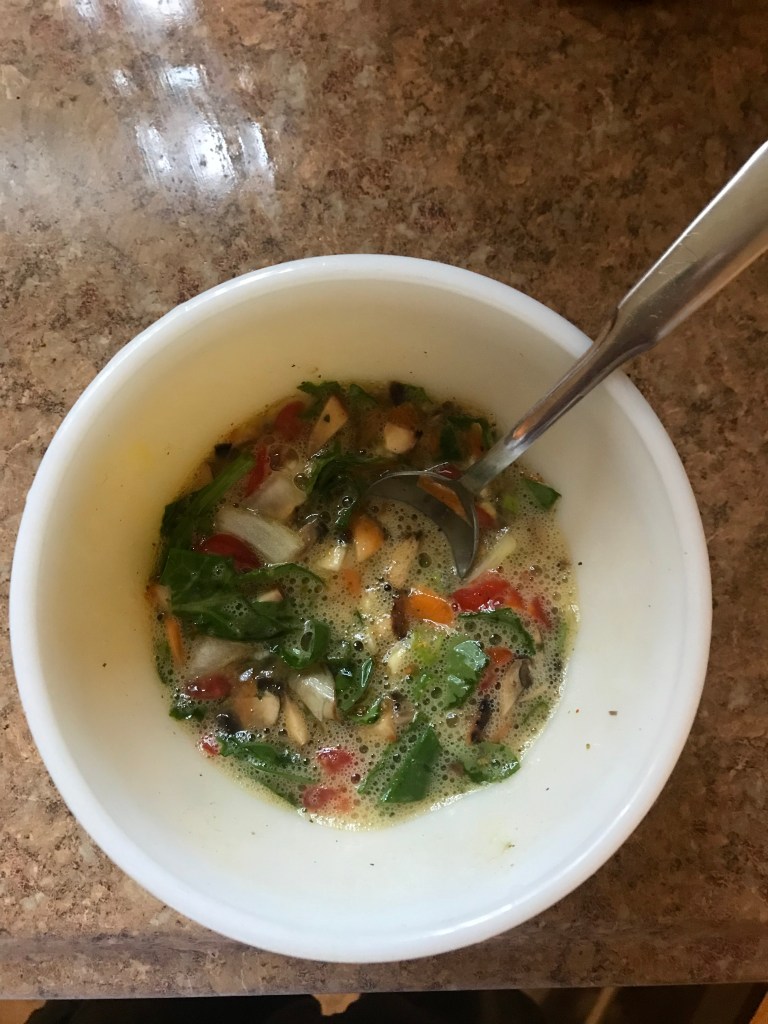
So—I make my eggs like this: I put about 3~4 egg whites in a bowl, keeping a smattering of the yolk from one of them—like a quarter of it. Then I add oregano, pepper, garlic powder, turmeric and chili pepper.
Next come the vegetables: Sliced & diced garlic, portabello mushrooms, onion and, grated carrot slices (they are like 2 microns thick) and scissored spinach leaves, scallions and cherry tomatoes.
Next, I whip it up so it is bubbly, and I put the concoction in the microwave with no oil—for 2 1/2 to 3 minutes. It slides out of the bowl and is ready to eat, filling the kitchen with a spicy, hearty and delicious aroma. Try it and enjoy.
About six to eight months before I left Japan, I gave up alcohol. I didn’t so much as have a problem with it, as I learned a lot about its deleterious affects on the body from neuroscientist and ophthalmologist Andrew Huberman. As it turns out, it doesn’t matter how little you drink so much as the regularity of your drinking in it potential to damage your organs — including your brain.
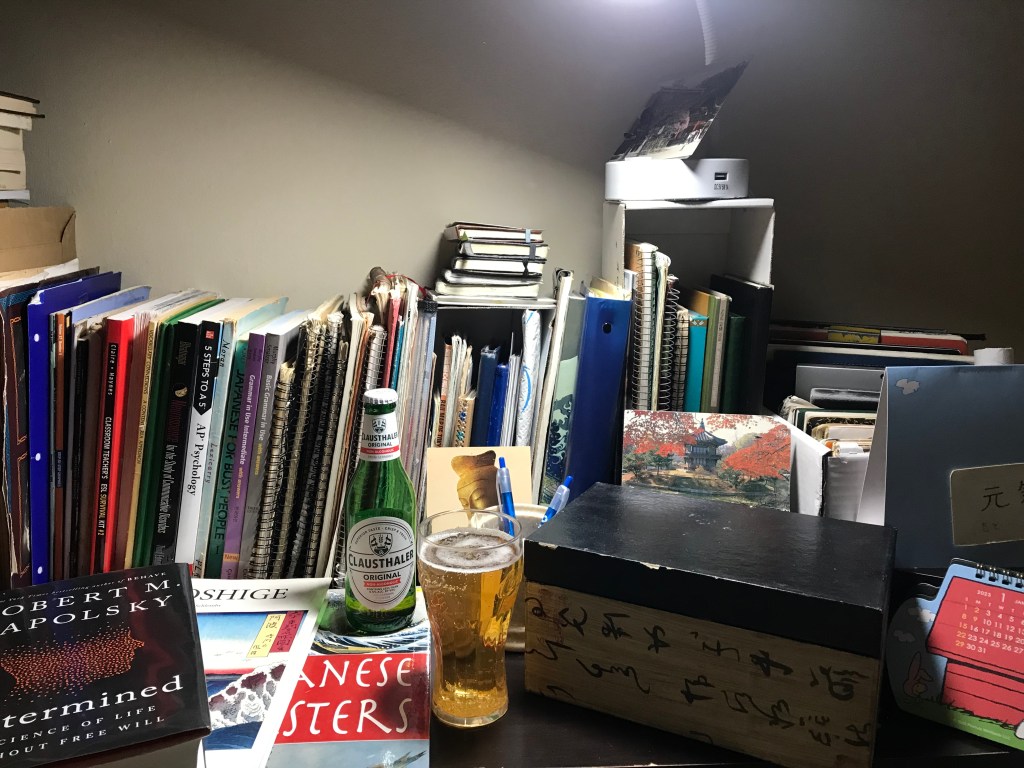
It doesn’t take long for me to apply iron will, once I’ve learned something from science—so, except for a few shots of sake with a friend before leaving Japan, and a couple of beers with my parents in the first months of my return to New York—in about a year, I really haven’t drunk alcohol at all. And — to my delight, my father, now, has taken a greater interest in his health—and has impressed upon me his desire for a steady supply of non-spirited brew; we now buy it regularly—and I am thus a fan and experientially moved to say, I love it. Of course I will have to take note of how much I consume — because I really want to re-acquire my six pack (the one I had in my abdomen before I left Japan — not the one in the refrigerator).
To clarify the point made above — having said that I “didn’t have so much as a problem” with alcohol—I should say that while on Geoje Island, South Korea—in probably the most important teaching assignment I had ever had (Cause it had been acquired through the auspice is of my ex girlfriend – who has meant a lot to me), I had my first allergic reaction to a bad can of Guinness—it cost me my job, because the English Services company I was working for out of Gangnam had though I was on drugs; I came to class and after a half hour was seeing aura (a prelude to migraine) and I had taken i’ll and had to avail myself of the facilities—and, in 2014 a re-occurrence of this happened in Lakewood, Colorado—after again—one glass of an IPA; I was sick within an hour. never happened before in my life. So — for the next 10 years or so — I was very careful about what beers I drank. In Japan I only drank Yebis or Asahi. I learned that some beers have surfactants in them. Some people are allergic to these…. It’s also true that these additives can be found in cheap, processed foods and in diner food. I know, because I had a similar experience after eating in the Lynbrook Diner with friends in 2017; I had had no alcohol at the time. Since then, I had tried to find “non-–hoppy” beer—thinking this was an issue, too. But I would still sometimes get a migraine the day after drinking, and I have never been one to drink a lot; I realized as a young man that there is no point in drinking so much that one gets sick. Well — I guess health caught up with me and alcohol in another way. So — not being one who needs alcohol to feel good, I just gave up having it all together, and I’m happy that I probably have a healthier brain and organs in my corpus for it. At least that’s the idea. And I hope—as experts say, will probably also reduce the risk of major diseases on this bent. This is something I think that vegetarians also benefit from — and now, removing alcohol from my diet may double those benefits! I encourage you to do the same.
What I do miss is saké. So—I hope to find that some company procures a non-alcoholic version – because there is great delight in the aroma and heat of a hot flask of the Japanese rice wine—and as pleasant is an ice-cold one. I do plan to drink again when I am back in Japan – minus the ethanol!
I was just talking to a young woman at the place where I got my glasses; she’s doing edu, and thinking of teaching English here – in the states – so, of course – I was selling her on Korea and Japan.
But, here I am at the local cafe, in the five towns, and Blondie is singing – before that it was Pat Benetar, a Long Island native, so I feel so “at home”, but if I have to stay in Long Island another month, I will be in the loonie bin.