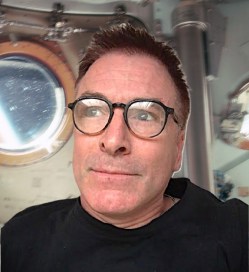
アテニジカール . 아테니에세만도: Art, Ideas, Voice, ESL & Zen / Welcome to 8 Fold. I’m Carl, from New York–in Japan and sometimes in Korea. I make pictures, poems, essays, voices, podcasts, videos, am writing a book and sometimes I do comedy—but only when people and other animals laugh! Thanks for stopping by.
Tony Watkins graduated from Stuyvesant High School in New York City, earning his Masters from The Pacific School of Oriental Medicine with a specialty in acupuncture. He has published a book of Haiku, which can be found at Amazon under his name.
Mr. Watkins is the quintessential copacetic funny, light-hearted, healing intellect and friend.
I caught up with this trend-setting, world-trotting, bilingual, former expatriate ESL teacher, original thinker and offbeat-fashion-sense maven in New York City where he hails from—via Skype—from Tokyo.
Listen, laugh, learn and brighten your day as Tony expounds on the psychology of good and bad impulses and how we may channel them, the “unexplored Trump,” the fate of the Democratic candidates, his former lives in China, Mongolia and Korea, his English teaching, relationship advice, lessons for language acquisition, his wonderful pet lizard, Jerry and much more. He also reads from his book of Haiku and recites another beautiful poem.
Tony is a friend of mine and a wise, insightful, witty and multi-eye-wear-sporting ingenious friend of yours, too (you just don’t know it yet)! So you have to get to know him (and to know Tony is to love Tony—because he loves you, too). He also has some special recommendations in the areas of healing, good books and good music. So listen “good!”
In a time when fake news is an issue, this is the antidote ー in a manner of thought.
Someone asked why lying is wrong, and this was my answer:
Honesty is the kernel of spirituality, all higher perception and related reason, self-knowledge, mental health, cognition, and relationships ーincluding with the self.
If you lie to yourself about anything, especially about your observations, feelings or beliefs, you will lie to others, which in the case of those who trust you amounts to a human rights abuse—of sorts; people who trust you, in private life or in business, depend on your honesty to understand the world that you reveal to them. If you lie, you paint a false image where they depend on you for an accurate one—and this his is deception, which denies them a true picture of the world which is important to them. It makes a fool of them in the worst way, because it makes a fool of them in such a way as it facilitates their making a fool of themselves–because they had decided to trust you. That is the heavy answer to your question and the one that matters most.
The light answer is: Honesty that is self-serving is a vice or a tool for self-aggrandizement; honesty for the benefit of others is a virtue.
In conclusion, dishonesty is the root of all problems as a factor in one’s not loving oneself and thus others. The only time lying is virtuous is when it saves lives and promotes righteous justice (which never, ever includes harm to anyone, for any reason (not even to facilitate punishment, which is primitive and which will one day be done away with).
The Buddha said it. Sages have said it. Jim Carrey says it. Even Sam Harris would say it — after a long, drawn-out answer to a question on the subject: that there is no subject. There is no “I”.
I have taken to saying things such as: I experienced this image/thought/idea… because though the conventions of Standard English demand I use the first-person pronoun to allow a listener to know who is doing the doing or the experiencing in my sentences (not all other languages require this — Korean, Japanese and Chinese don’t require the use of subjects), I do not feel authorship for most of what happens in my brain, and ‘I’ usually (not always) implies a sense of authorship.
We witness our actions and thought, but we say “I thought of something,” “I came up with an idea/solution/poem. I did this thing.” In reality, you might be good enough to admit, we have ideas, we witness solutions, we discover poetic verses. These things come to us. And when we finally get up to go to the bathroom, doesn’t it seem as if we could honestly say, ‘my body finally got up’, when I had just been thinking about it? Think carefully. How often have you decided your favorite color, taste, or even dating type. Doesn’t something inside you do this for “you”? I have been thinking about this for decades – long before I heard of or read Sam Harris. The point is, it is a phenomenon common to us all – if we are observant and honest.
The Buddha said the brain was a witnessing gland, an interpreter, an observer; actually he said it was a sense organ. We can manipulate what we interpret in the world, design sentences to describe it, formulate equations around the properties we observe or imagine to be responsible for the properties we think we sense in the universe and edit the words that come to us in the writing of a poem. But these things — these processes we invent come from inspirations, flash-points, touchstones.
Ideas: Whence Do They Come?
Many people will tell you — myself included — that we get the best ideas in the shower, or during other mundane acts, when basically the mind and body are united in a task that does not allow for too much ego-driven control. Some might be tempted to say that during these deeds, such as in the act of bathing, we are following patterns — some learned, some programmed by habit, and some just common sense: you drop the soap and pick it up in the exact same way you had when you were five years old — minus any age- or injury- inducing changes in your locomotion.
And this deed, be it watering the garden, washing your hair, or doing the washing up (the dishes) is a “thoughtless” activity — and yet, the brain “thinks” as freely as if we were dreaming. And we get ideas. Some might say these mundane acts should indicate the brain is in its programming (programmed) modse. We are doing tasks — such as cleansing, organizing or even driving the car — a more or less programmed set of rituals and scripted responses to the world outside — which we ingrained the memory and motor circuits of the brain to come to engage in unconsciously. But during these acts of washing, working mindless tasks and driving, we sometimes find it more obvious to notice what the brain is doing behind the scenes all the time: thinking for itself. So, I would say that that part of the brain is on “auto-pilot”, whilst the rest is in “free-flight” mode. And this is where our genius comes from.
Einstein imagined the scenes that became his basis for the theory of relativity. He saw himself riding a light beam through the cosmos. He wasn’t in the shower, but haven’y we — in our busy lives — been deeply involved in working with water, as I alluded to, before — when we have experienced ideas we wouldn’t honestly say we authored?
Bears And Big Thoughts
I remember the first time I bathed in a roaring creek. I was on a back country camping expedition in Colorado — with a girlfriend. We had no other way to wash. Well, I can tell you that in bear country, you don’t blithely dream away a twenty-minute period amidst dense forest as you throw frigid water on your naked body in the out-of-doors. First, you want to get the task over with, because the water is nearly freezing cold. Next, you are scanning the horizon – which is basically a hundred yards in any direction, except up and down stream — for something big and furry that might want to miss the fish for a day for a side of human sushi and creek drink.
In the hunter-gatherer days, this is how people washed — carefully. Could it be that this was one of our first meditative acts in which the mind and body are engaged in auto pilot, whilst in the background the stirrings of conscious dreaming were in their infancy, in such a way as they could be called up today whilst we are in water? And in the time that ensued in which people became more used to this — effectively having our brains say, ‘fuck the bears’, I need a bath, this act of washing became more and more relaxed and automatic and so our contemplative thoughts increased at this time.
Sow we find ourselves, today, a hundred thousand years hence washing in total abandon — unless we have to make a commute. Could it be the body (or the part of the brain that is the body) tells the mind it is okay, now, to take over — when we are touched with water — because of our nascent experiences as a species, always in thought — with that medium?
How dangerous is Artificial Intelligence? Chances are you are viewing this thanks to a device in your hand which constitutes AI in many of its functions.
Are Elon Musk and Stephen Hawking right in saying AI is the greatest potential threat to humanity? Sam Harris (samharris.org) originally thought their pronouncements to be hyperbolic — but now he agrees and adds that the only scarier potential prospect regarding AI besides developing its super-intelligent, self-learning and self-replicating AGI (Artificial General Intelligence) is not developing it, because it can solve our problems. ‘However’ — Dr. Harris points out — ‘if we develop to the extent that it is a million times faster than the greatest human minds, it could go through 20,000 years of human intellectual development in a week.’
Harris goes on to say that we will have deprive AI access to the internet at first — how we have to solve the political problems we have such that this thing does not cause unemployment at 30% — how we will have to program AI to not do what HAL did in the epic and prophetic film “2001: A Space Odyssey” (though he did not put it that way), because if you give AI instructions to protect humanity, it could wind up waging war on what it sees as deleterious or harmful members of humanity…. Sam Harris also worries about the fact that — as he put it — ‘some of the people working on this are keyed up on Red Bull and apparently on the Asperger’s spectrum; they have totally “drunk the Cool Aid” on AI.’
I would like you to let me share with you just one or two points about a book I’m reading, by Bertrand Russell.
Russell was a British philosopher writing the book I am reading at a time when things Christians don’t believe today were well-believed or recently let go of by them. That is a monumentally enormous point.
What Russell does–among other things–is make you realize that the arguments used a long time ago to prove God, etc., have changed, meaning (as we know) that what is acceptable about God and religion has changed due to intellect; this has the surreptitious effect of showing we make God, not the other way around. That is not his point–or at least wasn’t where I am in the book, right now, but I realized from yet another angle of approach that it’s our story, not His–though Russell doesn’t say that, per se. It’s consequential and deductible from the reading. He suggests it, or you glean it reading his debunking of old apologetics arguing for the proof of a god.
Russell isn’t heavy-handed. He does what great philosopher do–like some comedians: he illustrates tracts of reasoning based on observations you realize should be plain to all of us. He gives you “Ah ha!” moments. You find yourself saying, ‘a child could see that; why didn’t I think of it?’
He is funny. He goes into “God is good.” That’s hilarious. But he doesn’t approach it as people often do, with a litany of disasters. He goes into it sort of like ‘good as opposed to what–by what other cause’s standard?’
That’s what I love about philosophers. Like comedians, they are so plainly and obviously insightful where others are stark raving blind that they can deconstruct the arguments ignorant or unintelligent people take for granted, for lack of looking and caring–either because they wouldn’t even know to look or because they are afraid to.
The important aspect about philosophers and scientists is this: they approach their subjects out of honesty, sincerity, naivete and innocence–in a spirit if good nature. The fact that they come to conclusions religious people dislike is a fact about the religious people, not about they who are the challenging philosophers and scientists; they don’t set out to hurt anyone or to aggrandize their situations, but rather their deeds indicate theirs are the epitome of lives utilizing free speech and free thought to better the world and our misunderstanding of it.
These are some of the topics Russell covers on the existence of a god:
The First Cause Argument
The Natural Law Argument
The Argument from Design
The Moral Arguments for Deity
The Argument for The Remedying of Justice
Other chapters:
The Character of Christ
Defects in Christ’s Teaching
And more….
Keep in mind this book was written in 1927. That fact stands to illuminate the debate raging now among prominant American, European and Muslim-American and Muslim-European intellectuals.
I first read Russell when I was nineteen. I am glad to be reading him, again. You should be enjoying this amazing thinker, too. His work is rather essential:
‘Why I Am Not A Christian’ by Bertrand Russell could do you and the world a lot of good, because you matter. That’s why he wrote it.
Why I consider myself a nascent Zennist, became a Buddhism and lean heavily on Stoicism–so may be a Stoic Zen Buddhist Not a Supernaturalist(or theist). I would have to say I was or am a philosophical Buddhist, a secular non-devotional Buddhist, or a Zennist. I don’t accept blame, punishment, evil–levelled at people–who, according to experience, deep analytical sense and neuroscientific evidence do not have free will—not in the way people think they do.
I don’t mean to sound arrogant, but I have invested too much time in learning and thinking to say those things are good or true. Honesty won’t allow it, and honesty is the road to psychological well-being, compassionate community, and any goodness there is.
I’m also an American, meaning I honor the best and most egalitarian interpretations of the Constitution, and I am what I like to think of as an “Athenian”— one who honors the reason of the ancient Greek (and by extension Roman) philosophers. Perhaps I am a stoic–or a Stoic Zennist–who does value love (the original Stoics, for all their graces and wisdom, are said not to have).
Now, let me explain the Buddhist part of my thinking,so you don’t confuse me with those who attach supernatural ideas to Buddhism; because I cannot accept super-naturalism—at all—not because I am closed-minded, but because there is no evidence that anything exists outside nature. It simply is non-sense. It makes no sense, if you think about it. I am saying that with love in my heart for you and all people who think there is something beyond nature. Asking, or telling–people to think nonsenseis sense, or truth is a kind of disrespect and rudeness, in my view–a trick (for those who know what they are actually doing), if you ask me…. And that’s dishonest, and love contains no dishonesty. And spirituality begins with honesty and love.
This is why it is pointless to ask me to entertain monotheism or the idea of life-after-death (a contradiction in terms)–ghosts, spirits, omens, Heaven, Hell, gods, devils, angels, demons–all of this is complete nonsense–to me. And if there were a god, he, she or it would know that those like me are honest–after all, this god would have made me the way I am and the universe the way it is: honest and clear.
For anyone who might happen to read this–who might hope to have me adopt supernatural ideas in one religion or another–it should be understood that this is impossible—for many reasons–all logical, all moral, all loving and sincere, integrity-based, honor-bound, and–all universally true in my mind and all personal as well. However, the easiest way to understand why it is impossible is one who attempts to use reason with me about anything unreasonable cannot succeed, mostly because super-naturalism is unreasonable on its face.
One cannot use reason to prove an unreasonable premise. Ever. And one who attempts it is being foolish. This does not mean I do not respect you, if you think there is a god or gods, a hell, a heaven and demons, angels and spirits; no–it’s the contrary. I respect you too much to indulge in something that I think, though comforting to you–is hurting you, corrupting your worldview and that of those you influence. I love people, I love you; and I cannot lie to those I love. It’s actually impossible. You can’t love someone and lie to him or her. That’s not love.
As long as I am in command of my faculties and freedom, I won’t play the fool for people, who in many cases may mean well, but are really out of the loop; and they think people like me, and all the great scientists, historians and philosophers, are the ones who are ignorant and deceived–which is really the quintessential example of irony; it’s backward and unfair–but I could and do love people who think the way I am describing.
My point is, spiritual differences should not stand in the way of science, government, society or most importantly, love. To each his or her own mind. If we cannot agree on that, we have tyranny, personal and then political.
Zen has kept me sane. A theism would give me false hope. People cannot pretend to believe–well, that’s not true; my feeling is most religious people are doing just that: pretending. I can’t do that. To me, spirituality is about honesty–in everything.
I am not hoping that these ideas break up friendships, partnerships and love. I am hoping they liberate people to be engaged in true love–based on honesty, with themselves and others.
I was raised Christian and took all the love and forgiveness, virtue and sincerity I learned in Christianity and internalized it, such that there is no mote in my eye. I do as the Prophet Jesus taught; I love all and serve all and hate no one, caring for all I can and being politically active for the reduction of suffering in the world–when I can….
What Is My Relationship to Buddhism, Then? And to Me, What is Buddhism? I actually am more correctly a Zen or mindfulness practitioner. But these practices stem from Buddhism.
As a person given to Zen Buddhist or Zen practices and teaching, I don’t pray to any one or to anything. I don’t pray—period.I keep in mind some Zen, Buddhist and Christian ideas and principles–and Stoic ones. And I meditate, which, among other things, is really just cultivation of the mind.
Maybe I shouldn’t call myself Buddhist or Zen–or anything. I sometimes experiencethoughts about this. Why label myself?;Krishna Murti said something like, ‘once you label me, you diminish me… However, I keep the connection to the practice for various solid and practical reasons that don’t work with the faith I was raised in. Prayer, by the way, in my opinion, is really placing thoughts in the mind (or as Daeheng Kunsunim said, ‘in the juingong’, or “True Doer” in our “inherent nature,or “root”.This manifests in our actions, observations, intentions and appearance, and this, I think, is where help comes from.
Buddhism is a way of looking at life and a way of behaving. It is a practice, not a belief system. In the Buddhist practice there is the concept called the Dharma, or “Dhamma”, in the Pali language. Think of it, for now, as “The Way,” but other translations could mean the laws of the universe or the teachings of the Buddha.
And as much as I admire the Buddha, I admire the ancient Greeks for their great philosophers, and what their mental rigor and virtue gave to Western society. As much I admire the Roman philosopher-statesmen, Marcus Aurelius, who took after them in reason and justice–so do I irrationally feel a kind of silly gratitude (not pride, because what is that in relation to birth–an accident)– I am grateful or appreciate ‘being’ Italian-Irish- American–of ancient Greek descent. This is not pride, for I had nothing to do with it–but it is a state of appreciation makings me feel fortunate for my lineage. But I am straying from of the path, here, and flirting with ego….
Of course – in a Buddhist sense, the significance of all this is an illusion, and realizing that and its worth is part of why I accept and appreciate, as well, the practice that resulted in my being given the Dharma name ‘Mando.”
Being Buddhist is to recognize the symbolic (and to some extent–proven… through astrophysics and chemistry)Oneness of all things, not the separations we artificially ascribe to everything and everyone, via ego, to make ourselves feel important or distinct. And this mindfulness helps make us behave better and fosters compassion and togetherness–instead of prejudice and division.
All of the above is foundation to the reason for why I support the Zen path and thetaking of a name that centers me in reality–calls me outside the ego of lineage, flag, and other man-made judgments, and calls me to a higher potential self.‘Mando’ makes me a better man. Carl is that guy from Brooklyn, raised on Long Island, the ego-centered American…. Mando is that man made better by introspection, meditation, learning, love and self-work….
I know that to some people it may seem pretentious to change one’s name. People like Prince and The Edge did it, and actors do it; Hiroshige did it, something likethirty times. ‘But these are great people; who does Carl think he is?’ My good friend Tony Watkins (named after the actor Tony Curtis), said about my Dharma name, ‘it’s all right, but to a Chinese person it sound a little like your name is “Philosopher”, or something.’ (Tony speaks fluent Mandarin).
In the West, women do change their last name when they marry. Did you know that Japanese woodblock masters often changed their names? That’s why I mentioned Hiroshige, above. It was done to protect one’s family, for one thing, among other reasons; they did it, at first, by taking on the name of the masters they were apprenticed to–which was an honor and indicated that a protege reached some admirable level of accomplishment in the craft of the “school” they trained in.
Long before I received this Dharma name, I had thought it appropriate for a thoughtful person to change his or her name–to better suit how he or she sees him- or her-self. After all, my father changed his name, too! And so did my friend Marcus (who also has a Dharma Name, to boot.) The first time he heard of Marcus Aurelius, he thought–‘Blimey, that’s the name for me’–so he changed his name from ‘Mark.’ (Blokes from England say ‘blimey’ instead of ‘wow’ or ‘awesome.)
The Words And Their Spelling In Korean ‘Man-do’ literally means Ten-thousand Ways, with ‘Man’ (pronounced “mahn”) meaning ‘ten-thousand,’ or ‘many,’, ‘limitless’, or ‘myriad’, and ”Do” (pronounced “doe”‘) meaning ‘way’ (which can also be written and pronounced “Gil”) – but as Mahn-doe’ (the way it should be transliterated from Korean, if Koreans would like all English speakers to get the pronunciation right) was transmitted to me by my teacher, and was conveyed to mean ‘Many Paths of Change.’
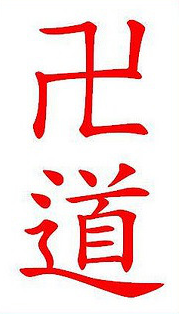
In Korean, Man-do looks like this: 만도
The name in Chinese is “Wàn Tao”, meaning basically the same thing — Ten Thousand Ways–or The Way of Limitlessness.
⇐ ⇐The Swastika(on top), is Sanskrit, and in that language it means “luck” or “fortune” and well-being, and it is, pronounced… ah…”swastika.”Surprise, surprise!
⇐The second character (on the bottom)–is “doe” (in Korean), also pronounced “gil” — and these words mean “way” or “path”. The Swastika, however, translated from Japanese and Korean becomes “Buddhism”, so together we arrive at “(the) Way of Buddhism”, or simply “(the) Buddhist Path”.
There is another script for reading the name with similar meaning, and this comes as a solution that solves (perhaps) a challenge which I have endured since auspiciously receiving this name–and that is due the possible reaction that may be engendered in Westerners who do not understand the meaning of the clockwise-spinning swastika–as they likely, consciously or unconsciously, associate it with that abominable ideology–NAZIsm. So here is what Chat GPT informed me of (and why my name is different in the masthead of this site):
(Note: this us of another script to inscribe and represent my Dharma name provides–possibly–for another problem, however, in that I do not wish to show disrespect to my teachers, most certainly toward the late and venerable Dae Heng Kunsunim, of Korea, who, via Chong Go Sunim, my friend and personal teacher (and transmitter of the name), conferred the name “Mando” (卍道 / 만도) upon me–holding, which carries a more succinctly eminent meaning and cherished symbolism in Buddhism. At the same time, I have often wondered if it did not serve as test of Zen practice, in affording me the opportunity to part with something and in so doing, diminish my ego–as all composite things are considered are impermeant in Buddhism. Indeed, when the name was given to me, it was translated by Master Chong Go as “Many Paths of Change”–further feeding my suspicion.)
Chat GPT: (Discussing Buddhism with a machine; I have corrected for its improper punctuational style)
🌟 1. Traditional Buddhist Symbol Form: 卍道
“Manji – Michi“:
卍 — the ancient Buddhist manji, symbol of the Dharma, virtue, auspiciousness, and the Buddha’s footprints;
道 — the Way / the Path:
Meaning: “The Way of the Dharma.” Strong, classical, lineage-pure.
🌟 2. Boundless Compassion Form (safe for international use)*
万慈道Man – Ji – Michi 道 — the Path. 万 — ten thousand; limitless; infinity. 慈 — compassion, mercy, loving-kindness.
Meaning: “The Boundless Compassionate Path.” A very balanced, soft, excellent name for seals.
* The swastika is banned in all its forms in some European countries.
In Chinese, that second character (道 ), or word,is ‘tao’ (or ‘doe’ in Korean and ‘michi’ in Japanese), is as in the Tao Te Ching’, or the “Way of Virtue”. This is the name of the collection of philosophical poems attributed to Lao Tzu (pronounced “Lao-zee” by many Chinese folks). Two of my Dharma Brothers—who took their Dharma names and precepts the same day as Ihad–have this word, “way,” in their Dharma names, too.
My Dharma Brothers are:
Cheon Do, 天道 (천도 in Korean) – “the Way of Heaven”
Gil Do, 吉道, (길도 in Korean) – “theWay of Luck”, or “the Way of Good Fortune”
Seok Chon,石村, (석촌 in Korean) – “Upright Stone” — which I take to me “Strong in Virtue“.
In Japanese, 卍道 (“Mando”) is “Manji Michi” (まんじみち), and the meaning is the same as described above.
The Swastika is a symbol that dates back to prehistory. It is a symbol used by the people of the Jain religion–arguably a more compassionate religion than Buddhism, but perhaps less practical? Jaines are said to drink through a sack cloth, so as not to inadvertently swallow any micro-organisms. They will also clear any path of life so as not to travel or build over it, harming any life in their path.
You can see the swastika all around Asia. This first character, ‘Mahn’, in Korean and Mahnji in Japanese, (or “Wahn” in Chinese) and Swastika in Sanskrit, is under the eaves on all Buddhist temples in Korea. It also denotes temples on maps in Japan. In this case it may be said to mean “Buddhism” or “Dharma.” That is because it was adopted to represent the turning Dharma Wheel, which is what it essentially is.
Imagine a cross, say of the two perpendicularly arranged bars that make up a compass, or of a window frame. Now, imagine it is spinning round the intersection point of the vertical and horizontal bars that make it–so that center is the an axis — around which the constructions turns. Now imagine it spinning faster and faster until it is a virtual blur , like that which we see when the cross shape of four-point-propeller–on an airplane–spins. Before it gets to that speed and after it begins to slow down, we may see tails on the edge of the four points. These tails are the outer bars that make the box-shape of the swastika. When moving, they circumscribe the illusion of that phantom box shape circumscribed by the tails in motion. If we could stop it and freeze the cross and its apparent tails–this is the swastika–the turning Dharma wheel of Buddhism, Jainism and Hinduism. That is how I see it. And it is what I have read it to be — somewhere; I don’t remember where….
A Little More About What Buddhism is… A. The assumptionshould not be made that a Buddhist practitioner believes this or that, though there are some basic notions accepted by many adherents and observers of Buddhism.
Buddhism, to some,is a religion, but to many, including to many academics, it is a philosophy–as religions usually are about a supernatural framework–which to be honest, could be said to be part of Buddhism, because Buddhists believe in rebirth (which I do not).
To me and to my teachers in Korea, it is a practice (to some that’s the same thing, but for the purposes of this article, please accept my meaning that a religion–these days–generally, means abelief-system requiring faith in unproven things, which, again, technically should apply to the concept of rebirth).
Some would say Buddhism is my religion, but it is not—not in the traditional, modern-day meaning of “religion,” because I do not depend on something outside myself. And I do not “believe”anything. I feel I do not have the moral authority to “believe.” I instead know or don’t know, suspect or do not suspect, trust or do not trust, or I put credence in documented and tested theories until they can be dis-proven or improved by evidence.
I don’t assume, much, so I depend on my perception–of what I am a part of, attempting to be as good a part of everything as I can–so it is responsible, inclusive, singular, and thus affords my part of the universal Mind quite a beautiful point of view, I feel. It is almost like saying I am part of what is “divine,” rather than separate from it. If there were a god, I would think this pays it more homage than thinking I am something separate from its creation- but, alas, I have no moral authority to validate the idea of a god. In that way, I insult not the universe or any individuals showing the evidence of how the universe really works.
B. Buddhism involves a moral path of inflicting as little harm as possible. It also says that we must accept reality for what it is (to the best of our intellectually honest ability to tell the difference), not what we or some doctrine or our fears want. To me that’s selfish and produces greater illusions than our minds already create and it it fosters delusion. For me this is perfect, because I feel a religion or philosophy is only as good as far as it abides by reality and does not attempt to recast reality in some self-serving image. A good religion or philosophy also must not preach punishment or pain–only benevolence. Because malice is born of selfishness and no spiritual path should foster that, or it is not spiritual; rather it is maligned and necessarily prejudiced. These features make a religion or philosophy a bulwark against well-being. If you subscribe to practices against well-being, what is the point of having a spiritual practice? That would just be politics or aggression. And this is why some other religions wind up at odds with one another; instead of fostering well-being for all, they are self-serving. They make for the politics of retribution and dualism–that which Buddhism seeks to eliminate.
C. At left is my Certificate of Precepts. It signifies that I and my Dharma Brothers took vows and were witnessed in doing so, promising…
D. Buddhism is a non-dogmatic way of looking at the universe–focusing on what is honestly and plainly perceived–or, on reality as it is. This is emphasized in One Mind Zen, or Han Maum – the sect of the Chogye Order of Korean Buddhism founded by the teacher Dae Heng Kun Sunim, the former teacher of my direct teacher, Chonggo Sunim.
E. The Buddhist attempts to perfect Right Mind, Right Action, Right Thought, and Right Speech.
Some Reasons I Chose This Practice Are:
I. I was enamoured with the peaceful, mind-opening, and epiphanic ways of meditation.
II. Buddhism (or it’s offshoot, Zen) can bring one peace–in my opinion, because it is about being, acceptance and practice, and:
III. Being peaceful, which reduces and eliminates suffering, it is about not doing as opposed to doing –or not doing this or that.
IV. People who visit Shinto shrines saying ‘how to worship’, are confused, in my view, by Shinto practices, and the thinking of Buddhism (the practices of the two religions–or of the religion and the philosophy, respectively) are sometimes confused, even by some Japanese people. And more to the point, in Buddhism, people do pay homage to Kannon (Guanyin in Chinese), or the Boddhisatva of Compassion–Amita Buddha and others, but this does not really constitute “worship,” in my mind.
V. There are pronouncements as to how to live morally, but what is interesting is that the Buddha said to look at ideas–including his ideas–with the mindset of testing them, to see whether they are right for us. In this way–and most importantly in my opinion–Buddhism does not interfere with sentient conscience, a most superlatively necessary way of ensuring the primacy of reason, personal ideas, truth according to the developments in our body of knowledge and in freedom. In other words, there is no compulsion.One arrives at and maintains the practice of Buddhism, Zen and other forms of mindfulness via reason.
VI. Buddhism (or Zen) can bring one peace–in my opinion, because it is about being (and being peaceful, eliminating suffering), and it is about not doing as opposed to doing this or that–or not doing this or that.
VII. It is true that the Buddha suggested his followers not to depend on a god or gods, but rather on themselves. However, until one can reach a transcendental path, it is possible for theists to benefit from the Buddhist ways of Zen meditation and mindfulness. I have met several Zen Christians, and have heard of formal Zen Christian sects.
VIII. If one attempts to practice Zen Buddhism, specifically living a meditative life, she or he will be relieved of most–if not all–illusions and delusions, or at least be in the practice of recognizing them, so that following religions based on faith in stories that have no proof likely become impossible.
Remember, the Buddha told his followers not to follow what he said outright–but rather to investigate things for themselves.Each of us creates his or own moral universe, so one could take the meditation of Zen and leave the Buddhist elements of wisdom out of it, if one wishes. In fact, I think if more theists were at the same time Zennists, too–if they were Zen Christians, Zen Muslims and Zen Jews, they might find much more peace, because…
IX. Meditation and the Buddhist way–which are crucial to the practice–are about presence, awareness, listening and seeing clearly, and conducting oneself in such a way as to not contribute to violence in oneself–as we are considered all one–aiming to diminish ‘I’ and ego and not causing violence to anyone else.
X. The more I read about it, the more I felt and learned that this way of being was more honest and pacifying–spiritually, scientifically, and socially–than anything I had heard of or witnessed. For theists who feel this is “bad,” I suggest they look into it, and if they cannot part with their religions but still like Buddhist philosophy and practice, they can become Zen Christians or Jews, because:
XII. The practice of Zen conflicts with nothing–most importantly, with evidence, science, history.
XII. There is no worship in true Buddhism–though there are those Buddhists who are devotional. And although in Japan you can see translations of signage showing people who visit Shinto shrines saying ‘how to worship’, this is Shinto, not Buddhism (the practices of the two religions (or of the religion and the philosophy, respectively) are sometimes confused, even by some Japanese people. And more to the point, in Buddhism, people do pay homage to Kannon (Gwanyin in Chinese), or the Buddha of Compassion–Amita Buddha and others, but this does not really constitute “worship,” in my mind.
XIII. I feel part of a community of mindful people, worldwide, who are generally more peaceful, to the man and woman–for their culture of Buddhism.
Thank you for reading. I wish you and yours peace, love, joy, and enlightenment.
A poster on Instagram defended guns with a double-image picture of a woman being abused in its first frame, and in the second, that same woman is defending herself with a pistol. The caption read “This prevents this.” I commented that the scenario depicted in the second image causes the scenario in the first, remarking that it is a chicken and egg situation. The person who had posted the picture said people can be killed with knives and that there is a difference between giving guns to children and arming responsible adults.
What I Wrote in Response:
What I said still stands as a reflection of the evidence and as a monumentally flawed and solution-less answer to the problematic questions of conflict, ethnic and political tensions, domestic disputes, religious intolerance, hunger, poverty, illness, and crime–exacerbating violence in the US.
Guns do kill people, in enormous numbers–and it is because people have them that they can kill (it is also because they empower us and inspire us in unnatural and almost narcotic ways; see my article: “What’s Wrong with Guns in America”).
If the guns were harder to come by, so would be the damage they inflict. If guns were difficult or impossible to obtain, people wanting to do harm would have to confront one another at close range, giving a greater opportunity for human contact, interaction, conflict resolution, even a chance at surviving through defense and escape; most murderous interactions might not even happen. Stabbing someone is too intimate and yields a greater possibility for failure, getting caught, and self-reflection.
Saying ‘people will get guns anyway’ doesn’t change the fact that their violence would be voluminously reduced if their acquisition were non-ubiquitous; it would be harder to get them, so fewer people would have them—therefore, their use would decrease exponentially. In addition, there would be a greater stigma attached to them, a greater need for concealment, and thus the greater possibility of perpetrators with guns being caught in suspicious behavior.
It is clinically insane that one can carry around a device in society that can render another miracle of thought, feeling, and life (a human being) inert. I lived in Korea fifteen years. I never heard of one murder by gun, there–because there are virtually no privately-owned guns in South Korea. Some Russian gangsters were rumored to have them. Gangsters kill gangsters. The police basically didn’t even have guns the first ten years I was there. Would you like to know why? The people didn’t have them. So, there was no need for the police to have them.
The “kindergarten” example I’ve written of is the best example I can think of for illustrating the fundamental nature of the problem: if a boy has no gun, he has to get up the nerve to come close to you and hit you and spend a lot of time being intimate with you to beat you up. If he has a gun, he can kill you by mistake or intention, but both require only an action akin to pressing a button. It is perfect for success by error or insanity: virtually no skill is required. This is why guns are the weapons of choice among cowards and sociopaths; these personalities are indifferent to people and afraid of intimacy.
Perhaps the most sense offered on the gun problem in America is explained in the stand up act by the resident Australian comedian, Jim Jeffries, who points out the only reason Americans have guns is ‘they like them.’
He says it’s not an issue of self-defense or home security: ‘You can’t go and retrieve your safely-stored gun to fight an intruder in your house. What are you going to say—dazed and in your underwear, tripping out of bed—‘Wait, I’ll be right back?’ Then you would go to your combination safe, unlock it, and assemble the gun, load it or turn off the safety in the dark.’ It’s all nonsense. Sure it can be done, but with great difficulty. Jeffries then goes on to say that ‘in order for a gun to be useful in one’s defense, you have to keep it loaded and available.’ These are the guns killing people; ‘a person is seventy percent more likely to be injured a by gun if he has one in his house.’
All the statistics (statistics are reflections of real life in numbers) show that where there are guns, there are more extremely violent crimes. It’s logical and sensical because it is natural, probable, and true.
Guns are for crazy people, and so that’s why crazy people have the advantage, be they temporarily crazy or permanently—whether they are soldiers, police officers, criminals, or right-wingers—and the crazy people are the ones supplying children with guns—by mistake or on purpose—because, they are crazy. Now, who’s crazier; the crazy people, or the people following them?
You can’t have discord based on scientific ignorance and ignorance of ethnology based on fantasy and Victorian “science” driving inequality, tension, and violence if you are disabused of the fallacy that started it.
The problem is the word ‘_ace’, as applied to humans in issues of descrimination.
…
But hey, people seem to love that stupid, erroneous, misused, pernicious, and culpable word: ‘_ace,’ either because they are unaware of its bastard power, or because they want to believe they belong to another species (what the word actually means)!
If you want to help stop enthniphobia, inequality, and violence caused by ‘_ace’ in America get a brief scientific education in a few minutes on the internet, learn we are all one ‘_ace’ (one species)–literally, scientifically, actually… one-hundred percent matter of fact-ly–and…
Stop
Using
The
Word
‘_ace’
As
Applied
To
Humans
Unless
You’re
Referring
To
The
Human Race.
You will help create a paradigm shift in the language that will contribute to stopping the validation of ethniphobia*.
Think about it: you can’t be a species-ist against aliens from Mars because there are no aliens on Mars. Likewise, people can’t be ‘_acist’ toward other human beings because there are no other ‘_aces’ of human beings on this planet — in this geologic epoch besides — that of Homo Sapiens. Translation: there are no other races of humans besides the one you belong to. Period.
What people have a problem with–but are afraid or too stupid to admit–is culture. Some of us don’t like how others among us in certain ethnic and religious and class-oriented groups behave. But we are either misinformed to think it has to do with biology (‘_ace’), or we are too polite or frightened to admit it is about culture, because we don’t really want to take the time, nuance, intelligence, and courage to say that.
Mando
___________
*Ethniphobia – as far as I can tell, I have made this word.
With all due love, respect, and compassion, your understanding of yin and yang is all wrong.
…
‘Good’ and ‘bad’ are egotistical concepts taught in Middle-eastern religions and which are the cause of all our problems, because they give rise to a prejudicial mentality and the time-honored and pernicious concept of “us and them”.
In Taoism and Buddhism these concepts do not exist, because it is the core and principal idea that says all is one. And this is actually true if you look at the chemical and physical nature of all life and all that makes up the universe.
The Yin and yang represent “opposites” of nature, not “good” and “bad”. In nature there is no good and bad, only a continuum of cause and effect.
If you bring the Abrahamic god into this, or Jesus, or Allah, it all becomes heavily laden with right and wrong, which, yes, are important to society — but which are the main reasons for all the suffering in the world: judgements of good and bad. This is why people don’t forgive and why they punish; it’s why they fight. It’s why they believe in demons and angels and gods in the first place, and it all stems from dualism — the attempt to balance opposite inventions that serve the ego.
All is one or part of everything else. As soon as people accept this, all conflict stops.
Yes, Yin and Yang represent opposites, but even this is a product of ego. Nature has no ego. It is all flow. It certainly has no good or bad, just a continuum of cause and effect, and that is relative, too.
It’s weird to ‘Down with Big Brother’ because he looks at the situation as he suggested: biologically. It is weird that a being has the anatomy necessary for it to reproduce with the complementary anatomy, yet its consciousness and hormonal system are attuned to the same anatomy, however, it isn’t wrong. It is natural and has been natural to a certain proportion of the species kingdoms since we can date back. Or at least it is in evidence in other species, including our cousin species of primates.
The challange is for us to look at life on the planet as a whole, instead of how Down with Big Brother tended to look at it — between only two subjects of Homan Sapian. In the species kingdoms it has been noticed that homosexuality benefits the social group, but people don’t tend to see the group as an issue or the tree of life as the unit to be concerned with.
Especially in Western culture, we think in terms of a fearful outlook that says, ‘if this happens over there, will it happen with me?’
You have heard this: ‘what if everyone did this?’ This is a product of insecurity, of the legal system, of moral laws, of religion, and specifically of dualism, which is a very West-centric or Western product very much fostered by the “us and them” aspects of individualism, “personal freedom”, and ego. The theisms play a huge part in this — unlike Eastern philosophies, which teach singularity — because the theisms succinctly teach good and bad, evil and virtue, Heaven and Hell, right and wrong, love and hate, forgiveness and punishment — all in the same book.
If one is raised in a mindset of oneness, energy-wise, biologically, cosmologically, interpersonally… dualism disappears and so does “us and them”. Homophobia can’t exist unless people are steeped in the illusions of dualism.
We had 378 signatures when I first wrote this letter to signatories supporting a ban on private campaign finance in America. At the time of this update and revision, there are about 700. Your signature–if you are an American citizen–is badly needed. When we attained fifty signatures, http://moveon.org wrote me a letter saying they would support me in sending me to my representatives to deliver this petition. I thanked Move On, but said that I would want at least a thousand signatures as a start to show Americans were serious about this issue. Indeed, we would need hundreds of thousands to move congress and the senate, if not millions. However, a thousand would show that is possible.
Thank you to signer #89: Ms. Dana N. of Provence from Alamosa, CO, who signed this petition on Nov 13, 2014. And, Thank you to signer #88: Mr. Gary Lamble from Escondido, CA, who signed this petition on Nov 13, 2014. Mr. Lamble had this to say: “The Seemingly Impossible Dream, but we need publicly funded campaigns and a ban on private contributions of any amount.”
Publicly-funded campaigns and a ban on private campaign finance would make all candidates equal in how much and when they speak to us. A system involving a set amount of funds for election–an equal amount for all candidates–would also take the corruption out of politics and out of our electoral system–or drastically reduce it–nearly ensuring that no corporation or individuals could curie favor with statesmen and women and thus undermine the electorate. Finally, it would put representation fairly in the hands of all constituents–unless a candidate wanted to favor an individual or group more than others–according to his or her conscience; then voters could decide whether to tolerate that or not–at the polls.
Right now we have a veritable auction system, a mechanism for bribery, and a machine wherein even moral, good-natured, and honest statesmen must compromise their values to satisfy their financiers, getting chewed up in the gears of near endless stumping, lip-service and rotten promises–so they wind up being bought by the sponsors greasing this smoke-spewing, gas-guzzling, ocean and air-polluting monstrosity which takes away our rights to have our voices heard and our wanted policies implemented.
Especially in a time of global climate change–to say nothing of issues related to healthcare (and climate is related to healthcare), gun violence, education, infrastructure, banking, and foreign policy–we need a government that answers to all citizens, not just to wealthy oil and pharmaceutical companies.
Take back your dignity, take back fair elections, and restore democracy to America–for Americans and the world. We are one dangerous nation, to our own citizens, and the citizens of other nations, without it.
There is no place for oligarchy on Earth now–least of all in America. Sign to ban private campaign finance and put the power of the American people back in the hands of the American people–where it belongs.
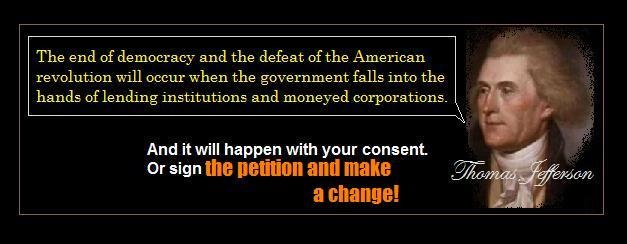
Thomas Jefferson said democracy would end when the government fell into the hands of moneyed institutions and corporations. That is what happened a long time ago. Is there any doubt in your mind that if we accomplished a majority of support for fair politics like this, that we would not be able to solve our problems, instead of spending decade after decade of just complaining about them and making nearly no progress?